How to Stop California from Burning Down
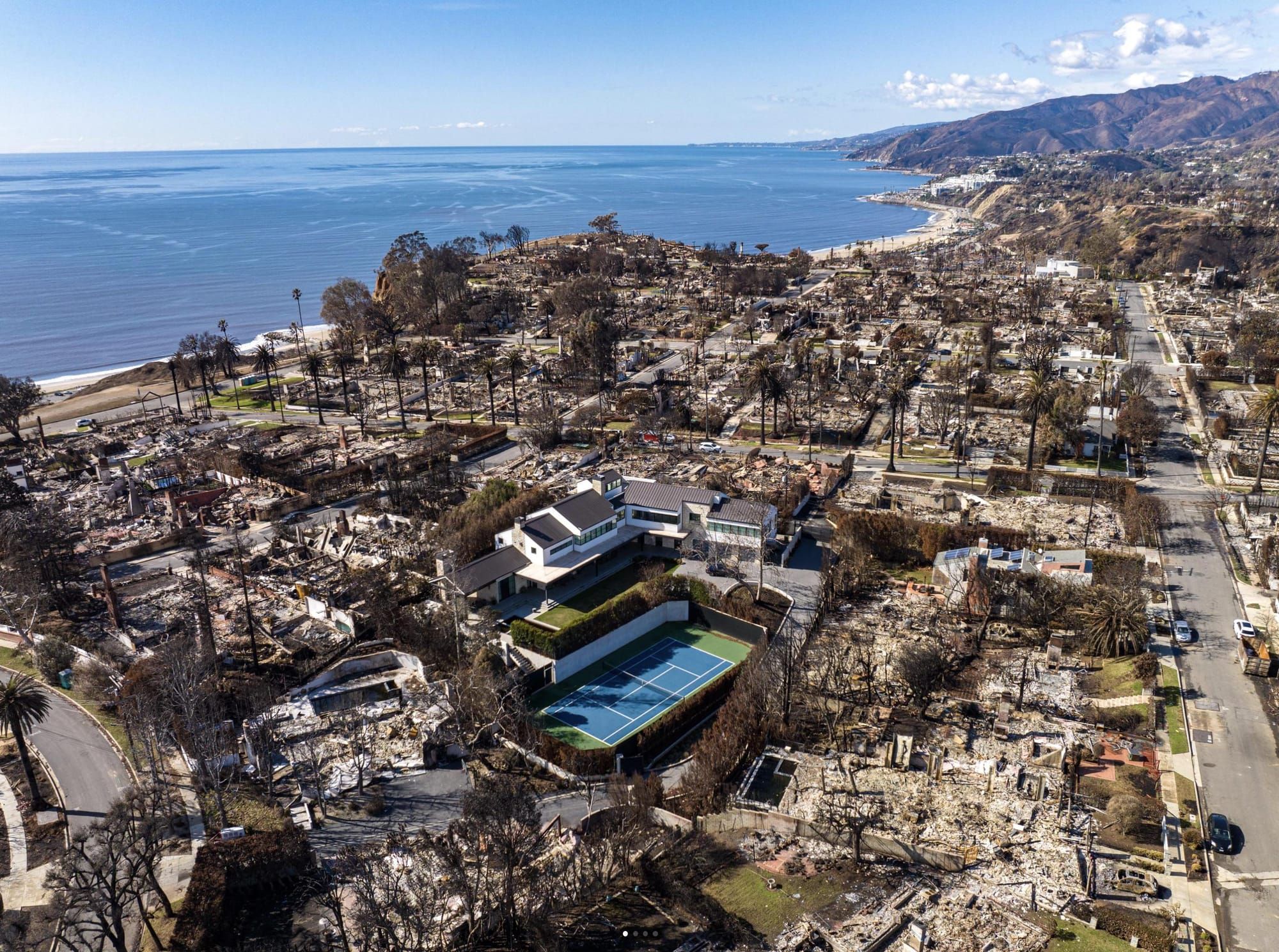
In 2020 alone, 4.3 million acres burned in California, an area larger than the entire state of Connecticut and most of Rhode Island combined. $160B in direct economic damage in the last decade alone. Fire related charges now add $41/month to the average PG&E electric bill.
And it’s getting worse, fast. Fires are now burning eight times more land in the West each year than they did in the mid-1980s. Half of the most destructive fires in California history have occurred in the last ten years.
Unfortunately, there’s no silver bullet to wildfires, no singular solution. Instead it’s a messy mesh of overlapping partial fixes.
They’re being brought to market by capital intensive startups often operating in textbook examples of the tragedy of the commons.
They must get many slow-moving, conservative, even dysfunctional stakeholders with misaligned incentives and tight budgets from municipal governments to federal agencies to utilities to work together.
And yet it feels surprisingly more tractable than we expected.
Not that it will ever be “solved”, but that credible solutions are being developed and the politics seem to be moving in the right direction.
How to Stop California from Burning Down
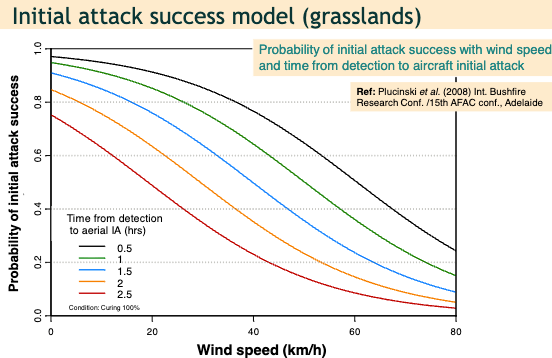
Effectively mitigating wildfires entirely comes down to prevention and putting out ignitions as rapidly as possible.
Everyone agrees that once a wildfire is raging to the degree as in fires like the Palisades, it’s too late.
The catastrophic fires from Camp to Eaton to Palisades are all blown by wind speeds of 40-50mph with gusts up to 100mph. They typically reach ~200 acres within the first 45 minutes. Palisades spread 7 miles in the first 90 minutes and had internal temperatures of 2,000°F. They’re effectively hurricanes on fire.
If you don’t stop fires within say 15 minutes on red flag days with extreme winds, there’s simply nothing to be done except watch and pray.
Prevention
First off, by far the single most effective lever to prevent fires is rebuilding our structures to be more fire resistant. Some low hanging fruit can be done like landscaping or replacing wood doors, but for the most part that societal transformation will of course happen gradually over decades.
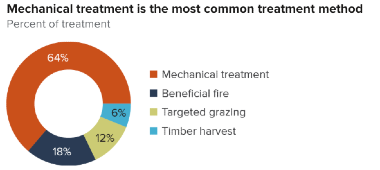
In the meantime, mechanical thinning and prescribed fires can reduce the intensity of fires on forested landscapes by 70%, as nature and indigenous populations figured out millennia ago. Treating chaparral landscapes like in SoCal is more difficult and more about creating defensible space.
California alone is home to 20 million acres that need to be treated and retreated every seven years.
But between regulation, liability, and understaffing, we’ve made prevention exceedingly difficult to do. Out of the 20 million, the state currently treats 700 thousand acres a year, including just 200 thousand acres of prescribed fire.
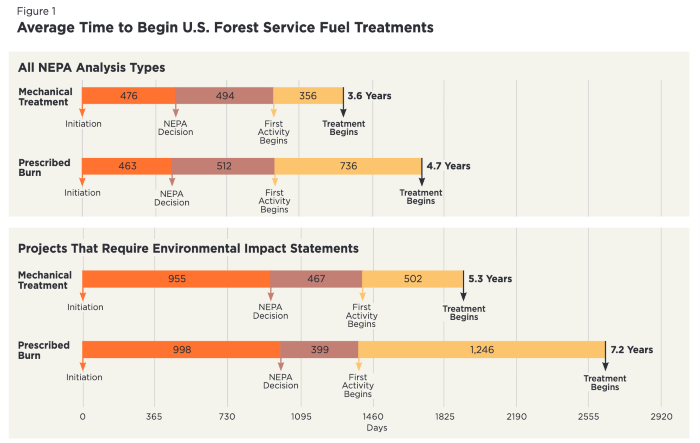
It’s tragically yet another example of the burden of our compliance state. It often requires sign off from multiple agencies (e.g. Forest Service, Caltrans, and/or individual land owners), any of which might say no because they feel like it.
Worse yet, it takes 7 months to 3 years on average to get clearance. 40% of Forest Service staff time on national forests is spent in planning, assessment, and permitting!!
Luckily, the politics seem to be shifting. The IRA increased funding for preventative measures by 10x to $5B a year. The Governor signed an executive order that includes some form of permit fast tracking and set a goal to ramp to 800,000 acres and 1.5 million acres burned annually by 2030 and 2045, respectively. Now to be fair, a purported 2019 Sacramento permitting push yielded no results, and the state was still at half its 2025 goal. But permitting reform has finally reached broad bipartisan consensus and fire prevention particularly so. The first year since the 2025 EO gives reason for cautious optimism, as the state reports 385 projects fast tracked totaling 90,000 acres.
Additionally, as of two years ago, liability laws dictated that if you as a homeowner were conducting preventative burns on your property, a fire escapes and nukes all your neighbors houses, you were entirely liable. So that liability was the #1 reason that kept people from doing burns even if they were inclined to. That’s now changed where Cal Fire would now be liable.
Lastly, crews would only perform burns in certain seasons and under goldie lox conditions (reasonably so), which would further limit or delay projects that did get approved.
Beyond bureaucracy, prescribed burns are limited by understaffing. Pulling stumps out of the ground and safely burning entire forests is a deeply manual job. Cal Fire has a couple thousand people on staff to handle 20 million acres. That’d need to 3-8x to meet the 2045 goal.
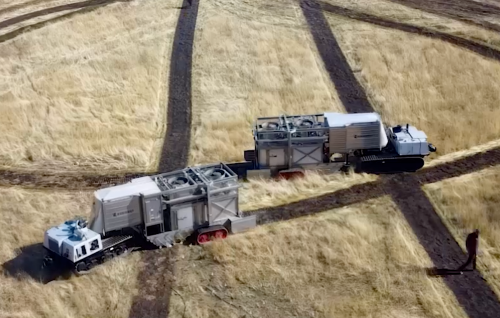
BurnBot built a tanker that scorches the earth underneath it using a combo of fans and propane to create an environment for a complete burn, while containing flame and smoke. In theory no fuel is left in its tracks. At the very end of the unit it does spray water for temperature control and to knock out any hot spots. This should reduce liability and allow them to operate in more conditions. Now, some are skeptical of the technical approach and whether the current iteration could be applied in many landscapes or is more efficient. And even if it is useful, it still will likely be hard to have a transformative effect because presumably people will still need to be staffed alongside it given the liability at hand.
The more exciting vein of work is advancements in hydrogels for both prevention and fire suppression because they can work nearly as well as burns at prevention and are far easier to scale. They can be as effective as prescribed burns and applied by simply spraying it.
Such a gel must be able to retain its internal moisture content for many months of dry external conditions as well as not wash off with rain.
Very roughly 1 gallon of mixed solution must be applied per 100 sq ft or 1-2k gallons per acre for effective prevention. The current retardant product costs around $3 per gallon.
Government agencies like Cal Fire are very unaccustomed to buying retardants for preventative use and only spend ~$100M a year on retardant anyways. Moreover, city and federal customers have at least 1- and 2-year sales cycles respectively given they must wait for budget approval proceedings. So, a better GTM for a new startup is likely a distribution model and/or selling to corporates.
A better model still may well be high-networth communities. One could sell the service of applying a perimeter around and spot treatments of their house or community. Each household would only require maybe a gallon of product, and a typical high-value cul-de-sac of 10 homes would need to treat 3–5 acres of immediate interface. It could applied automatically by robotic Super Soakers when embers are reaching the property.
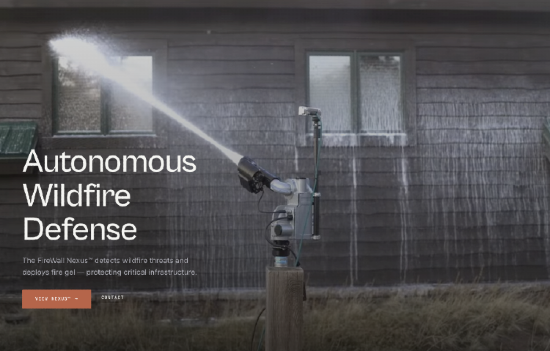
This would very materially lower the odds of structure destruction during practically all fires except for those with extreme winds.
Even in fires with extreme winds, for homes or critical infrastructure with more than 100ft of space between them and the next building, research suggests that they may be protectable.
A couple small contractors already charge $4-12k a year in subscription for similar services. Owners of $10M+ houses have even paid $12k per 12-hour shift for private fire fighters during emergencies or $100k for personal fire hydrants.
While disaster reactions sell at a higher price, preventing the disaster in the first place is of course the dream.
A key pie-in-the-sky question is if it’s possible to meaningfully chop off the long-tail of catastrophic fires like Palisades that are caused by extreme winds by preventatively applying such a fire retardant in and around a metro.
While such application on an annual basis won’t realistically be procured, one could imagine it being applied in purely preventative settings with no fire burning when a weather forecast of 30mph+ winds coincides with red flag days. The risks of uncontrollable catastrophe would justify the costs. That wouldn’t fully eliminate the risk posed by apocalyptic winds, but it could plausibly reduce the damage in such scenarios by say 20%. In a fire like Palisades, that’s $20B in economic value saved.
Detection
The average time for 911 callers to report a fire is roughly 15 minutes. In theory, cameras and satellites should be able to cut that radically down. For the last decade, utilities and other groups have been installing and testing this thesis. A publicly available resource has 1,200 cameras across California that includes almost all operational cameras in the state.
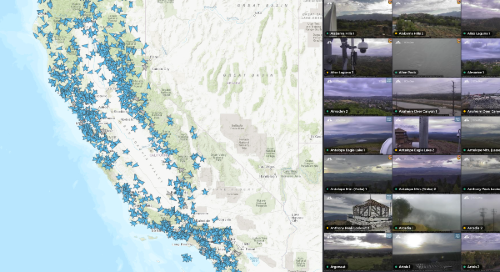
The results however have been somewhat mixed. PG&E reported no improvement in time-to-detection in the trial, though they were using a subset of their cameras and a CNN architecture trained on just eight A100s. The startup Pano claims to “consistently” beat 911 callers and charges $50k per camera per year for the service.
What has been glaringly missing beyond the limited use of cutting edge satellites and the seemingly weakly trained models is that the systems have tons of false positives, don’t do sophisticated climate modeling to precisely project likely danger, or tell stakeholders to do about it.
The satellite component is in the early stage of starting to be addressed, with Muon developing and just now launching the first 3 satellites with a resolution of 5 x 5 meters. But they only scan a given plot of land twice a day, with hopes to reach hourly by 2030.
Unless we're missing something the AI modeling still seems shockingly archaic given what's now readily possible.
There should be a unified platform such that all stakeholders involved have a shared operating picture and that immediately helps determine how to allocate resources. For instance in the Palisades fire, initially a vegetation response was dispatched; then while crews were en route, LAPD requested all water-dropping helicopters and 20 trucks. The first water drop happened 15 minutes after the 911 call, but by then it was 10 acres wide. Trucks reached the ridge to defend structures after 20 minutes and after an hour there were 20 on the scene. A system that could effectively model the physics involved, predict just how bad it would get, and call the right scale of resources from the start would have a better shot at containing such a fire.
A final possible tactic not currently done is on hot, windy days to launch surveillance drones or balloons preemptively to have 24/7 eyes in high risk areas for heat.
Fire Fighting
As the problem gets worse every year, we keep spending ever-more on putting out fires.
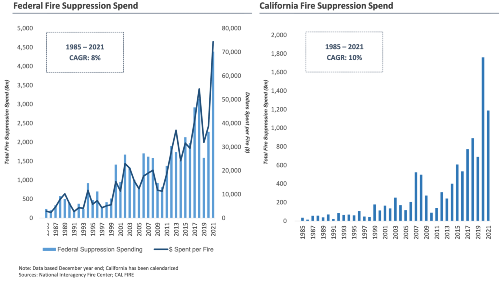
As mentioned at the outset, the key is to put the fire out as immediately as possible. Once a wildfire is raging in challenging conditions, it’s unclear how effective suppression currently is. Even large aircraft operations are only mildly effective at best, with firefighters often calling those ‘CNN drops’ because they look sexy on TV.
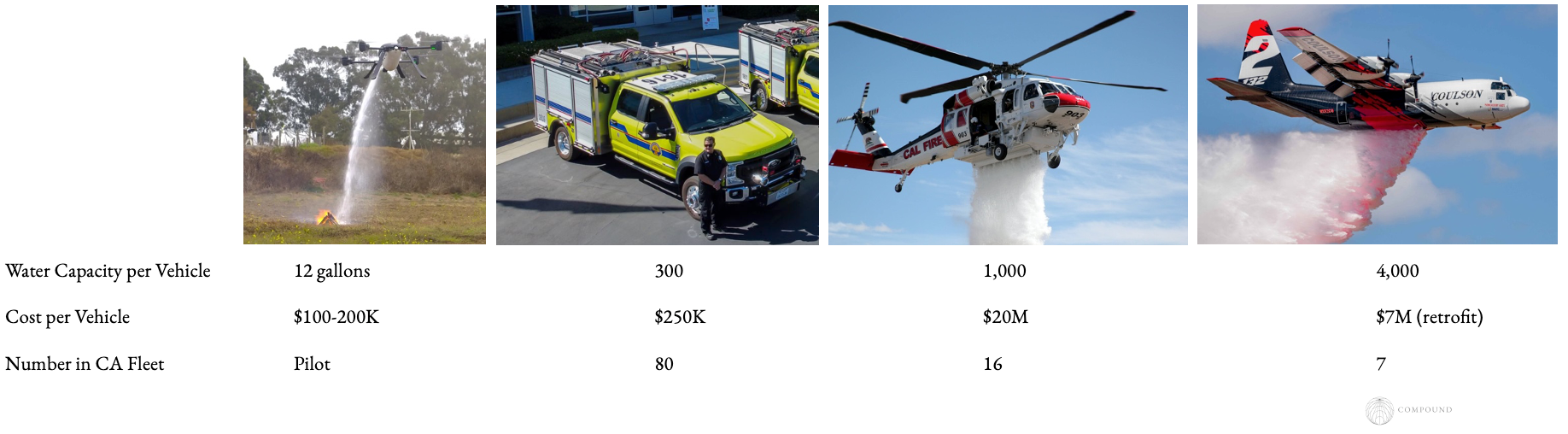
While drone's application to fires was quickly overhyped given they were the hot technology of the time, in this context of speed drones might actually be fairly useful. Even large purpose-built drones can only carry ~12 gallons of water which is just enough to contain a ~100 sq ft fire per drone. If they work as a swarm of five like Seneca recommends, then that's possibly up to a 50 ft fire front.
They likely won’t be a game changer in places that can easily be accessed by road because water trucks carry 300 gallons each and current systems cost roughly the same. However, they should be helpful in areas that are otherwise hard to access.
More than anything, drones are a cheap ‘force multiplier’ relative to helicopters or airplanes that can be rapidly deployed to scope out the severity of the problem and begin work to contain it before it gets out of control. Their cheapness and ease of deployment is crucial because the cost of aircraft flight time is 60% of total suppression costs.
A far cheaper version of (the seemingly over-engineered) Seneca systems would be impactful. If fire fighting drone swarms were say $100K instead of $1M, they could purchased by cash-strapped fire departments at far larger volumes, have much higher density, and be deployed without any hesitation over cost to get to fires within 5-10 minutes of reporting.
Moreover, cheap drones would give fire departments the ability to manage many more fires at once during during red flag days when they're often spread too thin, as this tragic LAPD excerpt below illustrates.
According to radio traffic, LAFD crews were at almost the same time responding to two incidents in other parts of the city. Both said they would send resources when they could.
Several minutes later, an official fighting a small brush fire in West Hollywood told dispatch: “We’re working real hard to spare as many resources we can.”
For the next 10 minutes or so, firefighters called back and forth, asking who was responding, who was on scene.
An official said at 10:48 a.m.: “Currently, it’s a 10-acre brush fire and heavy fuel on top of a ridge line. It is 100 percent in alignment with the wind. It has the potential for a few hundred-plus acres in the next 20 minutes. We have a potential for structures being threatened in the next 20 minutes.”
Radio traffic records show that fire trucks were still en route to the fire 25 minutes after it ignited.
Once a fire is underway, all vehicles must be used together.
Mothership Concept
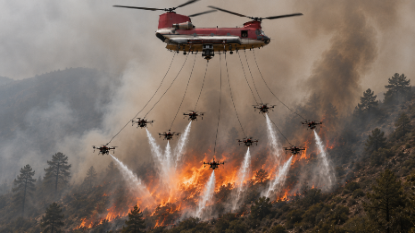
One premise for fire fighting hardware we haven’t seen discussed is a mothership concept, where either a helicopter or a blimp carries large volumes of water which are then more tactically and precisely sprayed with smaller drones attached. With large aircraft, 25-60% of water doesn’t reach the fire either because it evaporates, gets blown away in the 40mph winds, or otherwise misses the target. This concept would allow for smaller drones that could get closer than Seneca’s (which must stay ~40ft away to avoid fanning the flames with oxygen) and don’t have to constantly refuel. However, it’s attached to deploying expensive large aircraft.
Safe and Effective Hydrogel for Suppression & Prevention
Another, easier solution to that drift problem is to devise hydrogels with added physical weight and a protective coating to lower the odds of evaporation and being swept away in the wind.
There’s currently an opening in the market for fire retardants to be filled by a safer, superior product. The current monopoly provider, Perimeter Solutions, is a $5B publicly traded company from the 1960s whose product has had ~100% market share in aerial retardants. But it isn’t allowed in Europe and parts of the US for environmental concerns. While they say they’re attempting to develop a friendlier version, innovation isn’t in their DNA, the product they tried to launch was acquired by a third party developer, and then they wrote it off as an impairment which some argue is because it cannibalizes their core business.
A more effective and safer version should over time not only take market share but dramatically grow the market. In large part because of drops’ limited effectiveness and environmental concerns, fire retardant is used in only about 5% of wildfires and spend on retardants is only 3% of overall suppression spending.
Insurance
Insurance is the only balance sheet on earth that's directly financially aligned with loss reduction. The company must understand everyone’s risks and has personal connection points with the property owners that it’s looking to protect. It can therefore both put significant capital towards understanding the true nature of disasters moving forward and to protecting homeowners and proactively reducing loss.
The startup premise that excites us most is pairing the preventative work (especially the relatively scalable hydrogel-type approach) with insurance.
Legacy insurance companies only operate where they can readily model the dynamics with their existing army of actuaries and for which the probabilities don’t change meaningfully year-to-year. Those conditions are no longer the case for natural disasters in the age of rapid global warming. Most major insurance companies’ wildfire modeling is based on a dozen or so inputs, largely limited to vegetation. When they do model wind or climate, it’s at very coarse levels of say 2 miles.
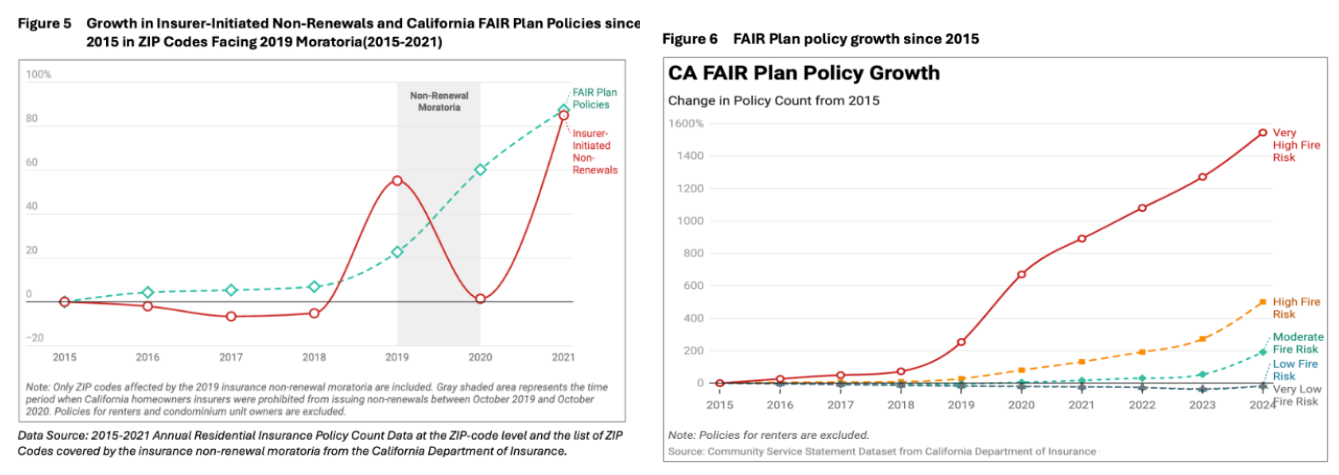
That level of sophistication led to huge losses and for them to exit risky CA areas en masse, leaving behind the FAIR plan that is now 6% of all policies statewide and 45% in very high risk zip codes.
When the in-house actuaries can’t easily model something, that risk underwriting shifts to hyper-focused specialty insurance and MGAs who make the decisions while renting out the balance sheets of a handful of large insurance companies. Typically in these arrangements, the large insurance companies funding the MGA’s policies get 75% of the premium with MGA keeping 25%. The insurance company pays all of the claims.
A couple of startups have entered the markets in their place with far higher precision modeling and thus far, far lower loss ratios during major fires.
Risk-capital companies typically trade around 7x to 8x EBITDA, while MGAs trade closer to 15x to 20x EBITDA, largely because of differences in financial risk.


It wouldn’t be ideal to compete against not only federal handouts but also other newish MGAs that must price roughly within ~10% of the FAIR quote. However, it feels somewhat possible for a new entrant to compete if they did have a truly scalable and differentiated prevention mechanism. About half of currently uninsurable homes are on the fence of being insurable and some further portion presumably is addressable with step function better tech. And while the homeowners of areas that you protect aren’t obligated to buy your insurance, it seems reasonable to assume most would.
Beyond novel tech, a key assumption that’d make it relevant for a new startup is that over time, ever more of the state, the nation, and the world fall under high risk zones for natural disasters so the growing market should be able to support multiple players.
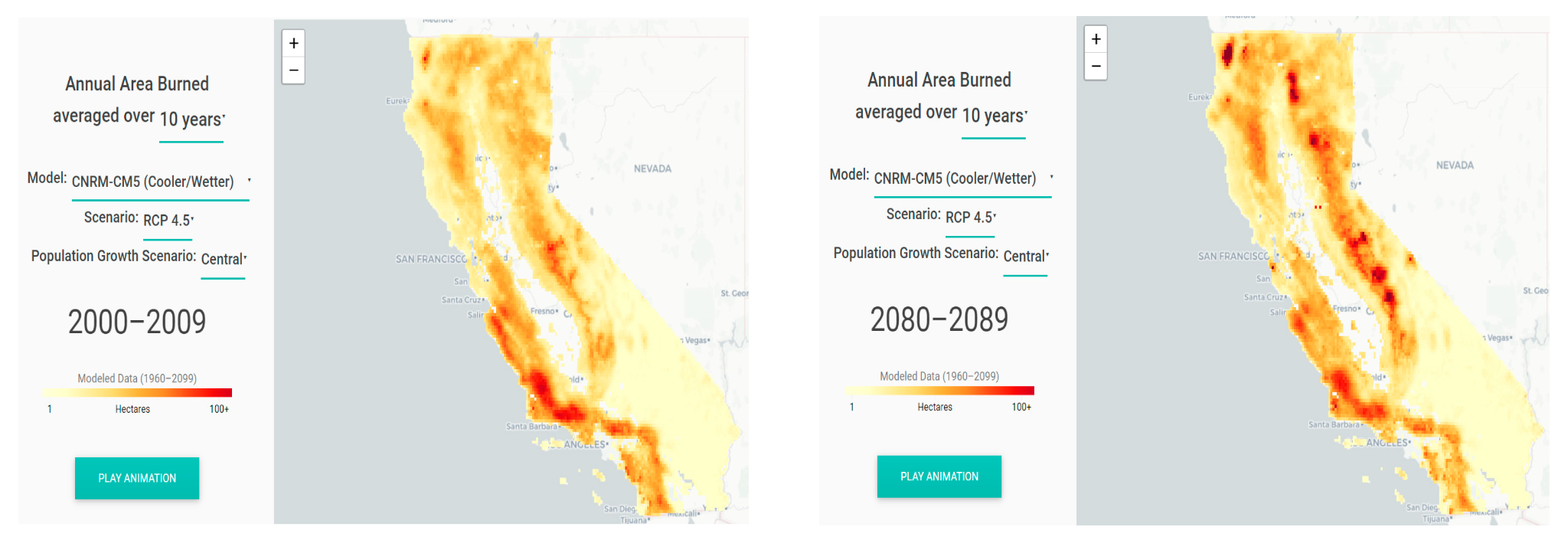
Startups are of course also a matter of timing. If that assumption doesn't materialize reasonably soon, then the opportunity to expand insurance beyond the currently high risk areas is likely muted, because more than 90% of CA policyholders retain market coverage and somewhat surprisingly the average premium remains below the national average.
Patchwork, Early-Stage Efforts to Pacify an Angry Environment
All told, we’d consider this a hairy problem getting ever-worse with messy, partial solutions that might just be enough to blunt most of the worst effects when combined all together.
Redesigning our buildings and landscaping for fire resistance, mechanical thinning, prescribed burns, preventative hydrogels, cameras and satellites for rapid detection and resource allocation, more fire fighting resources, and fast-responding and cheap drones. None a silver bullet; together a serious counteractive force if fully deployed.
In particular, we’re most excited about efforts that combine a preventative mechanism like hydrogels with specialty insurance, as they’re fundamentally aligned, effective, and relatively scalable.
We’re profoundly grateful to the people working in these challenging spaces and would love to chat with people developing new technologies & businesses that can scale.