What Is Quantum Advantage Actually Worth?

We’re nearing useful utility-scale quantum computers. And yet almost no one knows what they’ll be useful for.
Both the hardware and algorithms are on their own exponentials, with the hardware increasing in physical qubits by 50%+ per year and the resources required to run selected algorithms lowering by ~2x per year. The rate of progress on the algorithm side should accelerate substantially with AGI’s imminent arrival, especially given that it can be simulated entirely digitally and Anthropic already has a closed-loop going.
As the resources available and required converge towards each other, we should get useful quantum computers in the next 3-5 years depending on who you ask and how you count it. Nearly all hardware companies’ investor roadmaps project they’ll achieve a utility-scale computer before 2030. Given the diversity of physical platforms being pursued, it seems likely someone will crack it. If you instead base the estimate in historically realized results, then that number is closer to 2030-2032. Either way, quantum computing seems to finally actually be at most five years away.
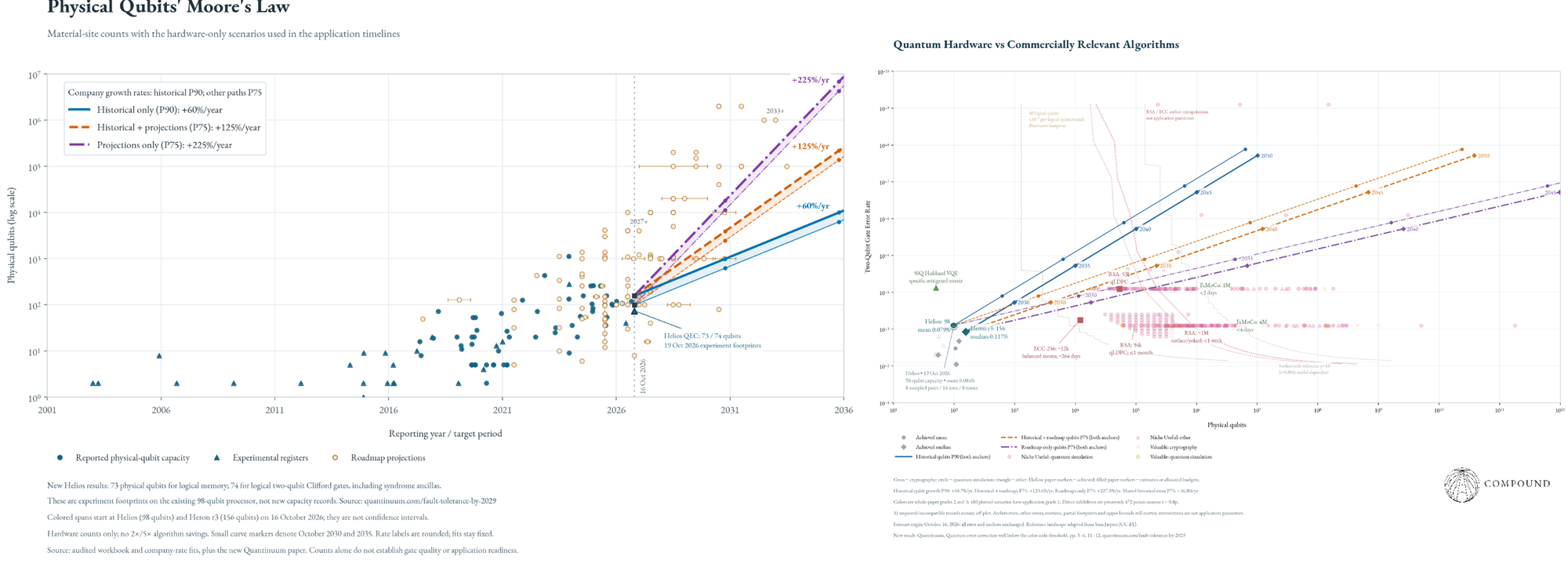
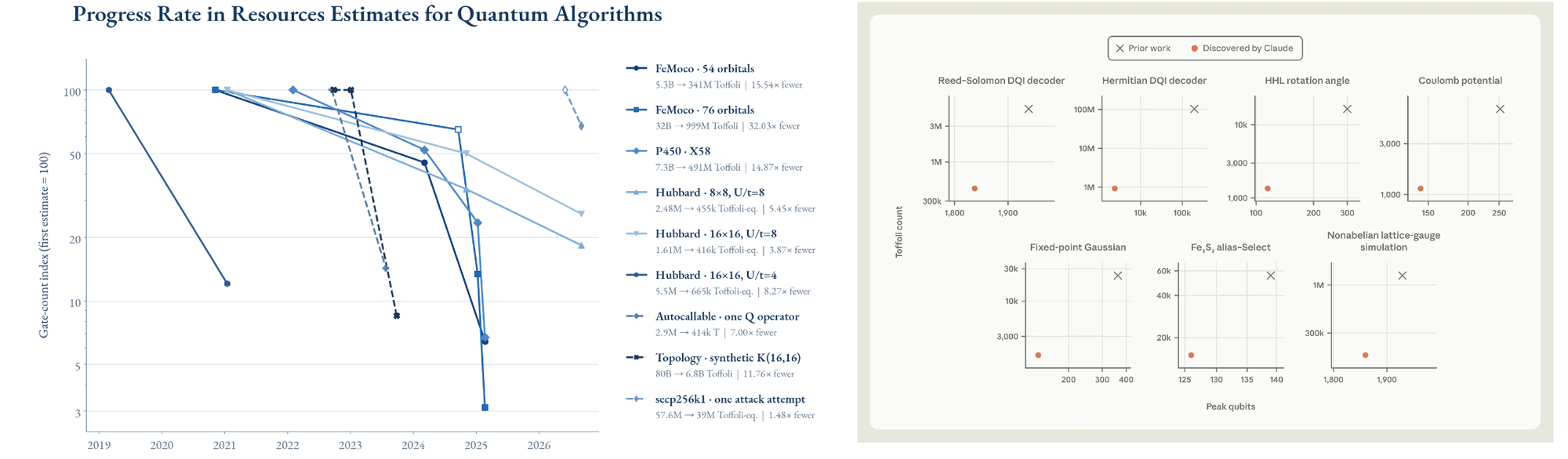
And yet, when we spoke with dozens of experts on the algorithm and applications-side, there was shockingly little confidence or clarity on how these machines will actually be useful.
The consensus is now that they’ll first be used for breaking cryptography. Indeed, Oratomic has raised $775M so far in its first year to build an ASIC specially built for that purpose. The second most concrete answer is generating quantum simulation training data for AI labs’ science modeling capabilities.
Beyond that, people hand-wavingly refer to quantum simulation for materials science and drug discovery. We at Compound have spent many years now studying the frontiers of classical approaches to both those problems and how to build viable businesses around them, including writing extensively on the subject and working with portfolio companies like Orbital Materials and Achira as they pioneer these fields. So we’ll discuss this application in detail below because we feel the field isn’t sufficiently precise in how it thinks about these verticals and business models.
Those applications are all well and good, but feel like combined single-digit-billion-dollar revenue opportunities, which is a concern for a field that has now raised $25-30B at $80–90B market cap valuation in just the last 5 years. It sets up a sort of dynamic like the infamous Sequoia $200B question blog post. That perspective turned out to be hilariously wrong in AI but feels more apt here, because investors are pricing these companies as if they’re the next general-purpose computing platform but almost all evidence (at least until a recent paper we’ll get into later) suggests it’ll be a far narrower HPC-type computing platform.
So how will these computers be applied and where will the revenue come from?
Quantum Simulation for Materials Science and Drug Discovery
The heart of the debate around whether quantum simulation can be a big enough market centers on where QC’s will have a definitive advantage and its value capture. Quantum’s speed up is most dramatic for strongly correlated electrons, emergent phases of matter, and exotic excitations. But these problems are typically more scientifically interesting than commercially valuable, like studying high energy physics. In other words, commercial value doesn’t scale with mathematical simulation complexity.
Even high-temperature superconductors, the canonical Holy Grail of entangled states, doesn't seem quite like the pot of gold they’re parroted to be as detailed in the thread below. That’s not to say they wouldn’t be lovely to have (e.g. cost effective 14T MRI machines is the only approach we’re aware of to simultaneously measure live biology across all scales), but that we’re not aware of any material that by itself would be a gold mine such that a major company could be built that only does initial discovery without any further productization.
People always point to superconductors as the Holy Grail in materials discovery
— Mackenzie Morehead (@mackenziejem) June 11, 2026
Am I missing something or is this a memetic phenomena where other ppl say it so the next person parrots it as if its fact?
Spent a bunch of time and seems less of a step change than expected
Moreover, we're aware of at least 5 startups specifically focused on harnessing classical computational methods for superconductor materials discovery.
A larger set of more commercially compelling application areas like those below sit somewhere in the grey area in the sense that they involve some quantum behavior but will likely be able to be simulated classically reasonably well in the coming years.
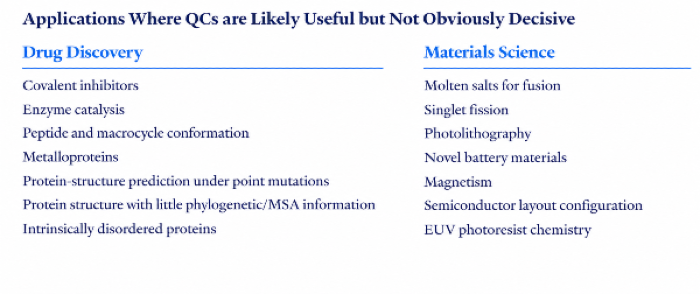
But, the core issue is that quantum computers aren’t being developed in a vacuum. They must contend with classical methods which are improving exponentially themselves and thus continuously move the goal posts for what it takes to achieve practical advantage. Classical AI methods are rapidly advancing at all scales and fidelity levels:
- Neural wave functions can exceed CCSD(T) accuracy and even converge to the Schrödinger equation itself and thus be used to accurately simulate exotic strongly correlated phases of matter like quantum materials and superconductors for systems up to hundreds of sites
- Neural network potentials are hitting chemical accuracy on macro molecule scale systems and have even been pushed simulations well into the millions of atoms (and beyond) for relevant problems like HIV capsids, SEI formation, diamond phase transition, and others (see our prior research on NNPs)
- Neural operators for simulating physics from fusion plasma flow to fluid dynamics to photolithography deposition
- Generative AI for systems from molecules through to the largest possible scales
Being very close to the frontiers of these fields, we’re confident that by the time that utility-scale quantum computers come online, NNPs will already be at or near chemical accuracy on many commercially valuable systems, which would dissolve the rationale for using quantum computers in these areas. Moreover, the classical methods will be able to train directly on data generated by quantum computers so they'll be able to converge towards chemical accuracy in problems where they still struggle at that point.
Moreover, in QC’s competition with classical methods, a currently open question is how cost-effective QCs will be to inference. Some of the utility-scale QCs are expected to cost $1B+ just to build. Presumably inference on such a machine wouldn’t be cheap and would push use cases towards the hardest, more niche problems or push the companies to vertically integrate.
For the areas where quantum computers do prove distinctly useful, their use is typically in the earliest stages of product development like in silico atomistic simulation. But as we detail in our research on materials science discovery and business models, the initial discovery is just the first step of many and at least as much work is in everything downstream from figuring out how to manufacture the material to commercialization, marketing, and distribution. Given that properly commercializing a discovery requires the work of a dedicated company in itself, companies with general discovery engines get pushed into being either a single-product company or a subscription- or usage-based compute provider to product companies. Having watched first hand our portfolio company Orbital Materials go through this, we’ve gradually updated our views towards being more product-centric.
Discovery (whether in materials science or therapeutics) is naturally a low-odds, high-upside endeavor where practically all the gains are concentrated in the player that creates a breakthrough end product. In such a market, the horizontal players providing flat subscription- or usage-based pricing to the product companies capture little to none of that upside.
They can try to negotiate royalties but effectively never do so successfully, from Gingko in years past to data generation startups in bio today trying unsuccessfully to argue for a royalty in the gains their data provides to the AI model.
To illustrate the point, Schrödinger has undoubtedly created $10B’s in value for the pharma industry providing force fields as a service, but it does $250M in revenue after 25 years and is valued at $1.7B. Meanwhile, its vertically integrated drug discovery spinoff Nimbus has collected in cash from its asset sales 3x the valuation of Schrödinger. That’s cash proceeds not valuation and also doesn’t include the value captured by all the other pharma using their platform.
A version of Schrödinger that can simulate arbitrary physical systems up to say macromolecule scale at arbitrary fidelity is likely a roughly order of magnitude larger revenue opportunity, implying $2-5B annual revenue for computations-as-a-service providers. But again that revenue pool must be split amongst the QC providers and the hundreds of relevant classical compute providers.
Maybe in the longer term as we push towards millions of logical qubits so we can simulate larger scales at long enough timeframes at perfect resolution and then use quantum inverse design to prompt your way to your desired material or have AGI treat QC’s as a purely in silico experiment. But such large scale machines are still roughly a decade away even assuming QC provider’s most optimistic investor roadmap trajectories. And our understanding is that useful quantum simulation will probably expand first through better local physics and higher throughput parallel computations than simultaneous simulation of large-scale structures.
Considering all the above, we at Compound would generally be most excited about product-focused teams using a hybrid of SotA classical AI methods with quantum when needed (e.g. see this paper pushing hybrid compute towards 12,000 atoms) with that loop possibly even orchestrated by AGI to create a specific product that’d otherwise be impossible or uneconomical.
Some particularly high value examples include simulating MOFs to finally achieve a universal e-nose chip (which if mass manufactured would be the most important advance in diagnostics in history) and building a chip or memory stack based on internal advances in exotic substrates like magnonics as we detail in prior posts.
Maybe a company could increase the durability of its moat further by co-designing algorithms with an ASIC for the types of computations common in quantum simulation.
Speculative but More Broadly Valuable: QML
While we’re skeptical the applications above will be large enough to support the aggregate amounts being invested into the quantum ecosystem, we recently met the authors behind a paper representing an advance in the theory behind quantum machine learning (QML) that made us more bullish even if it’s less clear whether the vein of work will pan out.
Previously, QML approaches involved storing the data in quantum memory, but a theoretical result proves such approaches won’t yield an advantage even with arbitrarily good hardware and loading methods so QML remained rightfully fringe. Instead, this paper streams the data continuously into the quantum processor, processing incoming samples immediately, updating a quantum model as more data arrive, and forgetting the raw data after the fact.
The theoretical advantage of such a QML configuration is that the quantum system allows for exponentially larger state spaces and thus a future functioning version of this algorithm could process exponentially larger amounts of input data than a classical AI system. For reference, 300 logical qubits is enough to represent all atoms in the universe.
This approach in principle could be applied to neural networks, recommendation systems, dimension reduction, etc. So it could enable things like:
- Frontier LLMs with practically infinitely large context windows, agent memory, or prompt sizes. Because the model updates to data being continuously streamed in, this setup could enable not just prompt sizes of arbitrary length (think of in Her where she reads all books on the topic at once) but even more valuable outcomes like agents with memory that can grow arbitrarily long without having to be compacted or losing fidelity. As more of AI inference is devoted to agents operating in the background with ever-longer task time horizons, this could become a market orders of magnitude larger than anything previously mentioned.
- Easily processing all the data coming off of systems that produce enough data streams. While the typical examples here are things like that are more of academic curiosities like CERN or particle colliders or astronomy, perhaps Midjourney Medical’s imaging platform that generates 800TB of data per scan scales to population levels or sequencing gets so cheap that we could do dimension reduction on whole tissues or organs
To be clear, this QML approach still has a long ways away from being implementable no less from running 1T parameter LLMs at inference. Indeed when asked when he thought that day would come, the lead author said that before Navier-Stokes his answer would’ve been 10 years. But now who knows maybe it’s a few.
Towards More Specificity and Rigorous Thinking
We’ve been shocked by both how few of the world’s preeminent experts can point to specific applications where QCs will clearly be commercially useful beyond breaking cryptography and what are viable business models beyond being a hardware operator (including repeated naive analogies to classical computing’s early days like comparing being a QC software vendor today before QCs are useful to Arm when that business model came 50 years after the transistor well after the hardware had commoditized and sold into an already gigantic market).
If Q-Day is indeed approaching in the coming years, the quantum ecosystem will need to rapidly hone its understanding of both what applications the tech is uniquely useful for and the business models to be built around such applications.
On the flip side, teams that have clear and thoughtful views on those points would have significant alpha over its competitors.